
ND.BUILDS // NOTES
· By Frank Milz
The John Ternus Era Begins: A New CEO, a New iPhone and Apple's Next Chapter
Eight days into the job, John Ternus used his first Apple keynote to put the iPhone back at the center of Apple's future, introducing the iPhone 18 Pro…
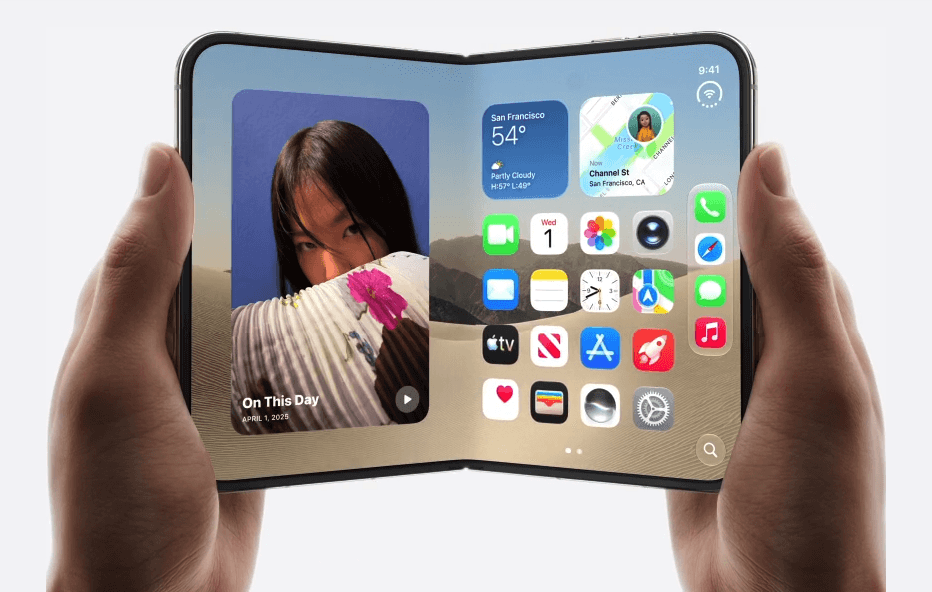
Apple has a new CEO, and it did not take long for John Ternus to put his name on a new era for the company. Just eight days after officially succeeding Tim Cook, Ternus took control of his first major Apple keynote and introduced the products that will inevitably be associated with the beginning of his tenure: the iPhone 18 Pro and Apple's first foldable iPhone, the iPhone Duo. For any Apple chief executive, a new iPhone launch would be important. For Ternus, this one carried considerably more weight. It was his first opportunity to stand in front of Apple's customers, investors, developers and competitors and explain what the company intends to become under his leadership. His answer was surprisingly clear. Apple is not moving beyond the iPhone. It is betting on the iPhone all over again.
Ternus officially became Apple's chief executive on September 1 after one of the most carefully planned leadership transitions in corporate America. Tim Cook, who led Apple for 15 years after Steve Jobs, did not leave the company entirely. He became executive chairman, giving Ternus access to his predecessor while allowing the new CEO to take operational control. The transition is significant because Apple has experienced remarkably little instability at the top. Steve Jobs returned to lead the company in 1997, Cook became CEO in 2011, and now Ternus becomes only the third person to lead modern Apple through a major technological transition. Ternus also arrives from a very different background than Cook. Cook built much of his reputation around operations and supply-chain management. Ternus spent much of his Apple career building the products themselves. He joined Apple in 2001, rose through hardware engineering and eventually became senior vice president of Hardware Engineering, overseeing work across products including the iPhone, Mac and iPad. At 51, he is also young enough that, if successful, he could lead Apple for a decade or longer.
That background made his first keynote especially appropriate. Apple did not introduce Ternus with a lengthy speech about corporate leadership or spend much time celebrating the past. Instead, the company staged a brief handoff from Cook and moved forward. Cook appeared during the opening before turning attention toward his successor. Ternus then became the central figure of the presentation. It was a symbolic transition, but it was also very Apple. The company acknowledged one era ending without allowing nostalgia to overwhelm the products that were supposed to define the next one.
The biggest of those products was unquestionably the iPhone Duo. After years of watching Samsung, Google, Huawei and other manufacturers experiment with folding smartphones, Apple has finally entered the category. The difference is that Apple is not presenting the Duo as an experimental side project. Ternus described the iPhone as the natural center of a user's intelligent digital life, and the Duo is the most dramatic physical interpretation of that idea Apple has produced in years. Closed, it behaves like a compact iPhone with a 5.4-inch outer display. Open it and the device reveals a 7.6-inch inner screen, giving users something closer to a small iPad that still fits inside a pocket. Apple has redesigned parts of iOS 27 around the larger canvas, allowing applications to run side by side and making the device better suited to multitasking, entertainment, gaming and productivity. Apple Pencil support pushes that idea even further.
The Duo is also unmistakably a premium product. It starts at $1,999 in the United States and can climb as high as $3,199 with the largest storage configuration. That makes it the most expensive iPhone Apple has ever sold and immediately limits the audience that can realistically consider buying one. The hardware helps explain some of that price. Apple built a new precision hinge, uses a polished grade 5 titanium body and equipped the phone with the A20 Pro processor, a custom vapor chamber cooling system and a dual-battery architecture. The inner display is designed to minimize glare, while the outer and inner screens use matching proportions so apps and content can transition naturally when the phone is opened or closed. Apple says the Duo can provide up to 24 hours of dual-screen use. Preorders begin October 16 before the device reaches customers on October 23.
Whether people actually need a folding iPhone is a different question. Foldable smartphones remain a small portion of the overall smartphone business, and their high prices have prevented them from becoming mainstream products despite years of development from Samsung and others. Analysts estimate foldables still represent less than 3 percent of the global smartphone market in 2026. Apple is betting that its entrance can change the perception of the category, but even analysts impressed by the Duo have questioned exactly who is supposed to spend $1,999 or more on it. That is a legitimate concern. Apple demonstrated Zoom, Slack, Netflix and other applications on the expanded display, showing that the Duo can function as a work device, entertainment screen and personal computer, but versatility is not the same thing as necessity. The first generation may primarily attract wealthy Apple enthusiasts and early adopters. Analysts nevertheless believe pent-up demand could allow Apple to sell millions before the end of the year and immediately become one of the largest companies in the foldable market.
The Duo also tells us something important about Ternus. Apple could have treated its first post-Cook keynote conservatively. A normal iPhone upgrade, a faster processor and a better camera would have allowed the new CEO to ease into the job. Instead, Ternus began his tenure with the largest physical redesign of the iPhone in years. For a leader who spent decades in hardware engineering, that feels appropriate. His first major product statement is essentially that hardware still matters.
That does not mean Apple is ignoring artificial intelligence. In fact, AI may be the issue that ultimately determines whether Ternus succeeds. Apple has spent the last several years trying to catch companies such as Google and OpenAI in generative AI, and the company has faced criticism for moving too slowly. Ternus used his keynote to position the iPhone itself as Apple's answer. Instead of suggesting that smartphones will eventually be replaced by AI glasses, pins or some entirely new category, Apple is arguing that the device already sitting in hundreds of millions of pockets can become the personal AI computer of the future.
The Duo is built around that philosophy. Siri AI, rolling out in beta with iOS 27, is designed to understand personal context across messages, emails, photos and other information while also recognizing what is currently displayed on the screen. Apple says Siri can take actions based on that context and answer broader questions while keeping privacy at the center of the experience. The larger Duo display gives those capabilities more room to operate, allowing users to combine applications, information and AI assistance in ways that would be more difficult on a conventional phone. Much of the processing is designed to happen directly on Apple hardware, with Private Cloud Compute handling tasks that require additional computing power.
This may become the central philosophy of the Ternus era. Apple does not necessarily have to build the world's most powerful standalone AI model if it can build the world's best device for actually using artificial intelligence. That is a very different strategy from OpenAI, Anthropic, Google or xAI. Those companies are competing heavily over model intelligence. Apple can compete by controlling the hardware, operating system, apps, personal data environment and silicon through which that intelligence reaches the user. Ternus effectively used his first keynote to put the iPhone back at the center of that strategy. It is reminiscent of Steve Jobs arguing decades ago that the personal computer was not disappearing but evolving into a digital hub for cameras, music players and other devices. Ternus is now making a similar argument about the smartphone in the AI era.
The other half of the new iPhone duo, in a broader sense, is the iPhone 18 Pro. While the foldable Duo attracts the attention, the 18 Pro and Pro Max remain Apple's conventional flagships and will likely sell in far greater numbers. They start at $1,199 and $1,299 respectively and use the same A20 Pro chip found inside the Duo. Apple improved battery life, charging performance and camera capabilities while adding a variable aperture camera system that gives photographers greater control over how images are captured. Apple also introduced new AI-assisted photography features and a system designed to help verify whether photographs have been manipulated by artificial intelligence.
That combination makes the 18 Pro and Duo an interesting pair to begin the Ternus era. The 18 Pro represents continuity. It is the familiar iPhone refined again with better silicon, cameras, batteries and software. The Duo represents risk. It asks customers to reconsider what an iPhone physically looks like and how they use it. One product protects Apple's enormous existing smartphone business while the other tests where that business might go next.
There is a certain symmetry to Ternus inheriting Apple this way. Steve Jobs' Apple was defined by product reinvention. The Mac, iPod, iPhone and iPad repeatedly pushed the company into new categories. Cook's Apple was defined by turning those products into an enormous global ecosystem while adding categories such as Apple Watch and AirPods and building a services business around more than a billion users. Ternus inherits both legacies, but he also inherits a new problem. Apple is already enormous. The iPhone is already mature. Smartphones are already everywhere. Finding another product capable of producing iPhone-scale growth may be impossible.
The Duo does not need to become the next iPhone because it is still an iPhone. That may be the clever part of the strategy. Apple can experiment with a new category without asking its customers to abandon the ecosystem they already understand. Messages are still there. Photos are still there. The App Store is still there. Apple Intelligence, Siri, iCloud, AirPods and Apple Watch still connect to it. The hardware changes dramatically while the relationship between the customer and Apple remains familiar.
There are risks. A $1,999 starting price makes the Duo inaccessible to many consumers. Folding screens introduce durability concerns that conventional smartphones largely solved years ago. Samsung has spent seven years improving foldables and still has not made them mainstream. Apple's first attempt will be scrutinized heavily, and any widespread hinge or display problems could quickly turn a celebratory launch into a public-relations problem. The company's AI ambitions are also far from settled. Google and OpenAI are moving quickly, and Apple must prove that its privacy-focused approach can deliver AI experiences that feel just as capable.
That is why this launch will probably be remembered for more than specifications. John Ternus did not simply walk onto the Apple stage and introduce another annual iPhone refresh. He inherited one of the most valuable companies in history and immediately placed its most important product at the center of his vision for the next technological era. The message from his first keynote was not that Apple needs to find something to replace the iPhone. It was that the iPhone still has room to become something different.
Tim Cook's first years as CEO were inevitably judged against Steve Jobs. Ternus will face comparisons with both of them. That comes with the job. Cook left him an Apple that is larger, richer and more deeply embedded in people's lives than the company he inherited in 2011. What Ternus has to prove is that Apple can still surprise people.
His first week as CEO produced a $1,999 folding iPhone, a redesigned version of iOS, a major Siri push and a declaration that the smartphone belongs at the center of the AI age.
For better or worse, the John Ternus era has begun.